King Pellinore
Le Morte d'ArthurKing Pellinore is a king and renowned knight whose defining pursuit of the Questing Beast brings him into Arthur’s company, while his later actions bind his family to the violence of the realm. His story joins martial distinction to lasting consequences: he earns recognition at Arthur’s court, regrets failing to save his own daughter, and becomes the object of Gawaine’s vengeance after killing King Lot.
Identity and Introduction
Pellinore is identified as a king and a knight of great prowess, known at first through his pursuit of the Questing Beast. He has followed it for a twelvemonth, and when he encounters Arthur he has killed his own horse in the chase. Seeing Arthur’s horse, he asks to borrow it so that he can continue. He declares his resolve to achieve the quest or lose the best blood of his body. The pursuit is not a single passing adventure: it is a sustained undertaking that shapes his identity and brings him repeatedly into the narrative.
The quest also gives him a memorable, if difficult, encounter with Arthur. At the time Arthur does not know Pellinore’s identity, and Pellinore takes Arthur’s horse to pursue the beast. Later, Merlin saves Arthur’s life and enchants Pellinore, putting him to sleep. These episodes establish the two sides of Pellinore’s early place in the story: he is a determined knight devoted to a quest, but his actions and fortunes remain subject to the larger designs of Arthur’s court and Merlin’s intervention.
Prowess, Service, and the Round Table
Pellinore’s standing rests on more than his pursuit. He rides after a lady and the knight who has led her away, then answers another lady’s appeal for help by fighting two knights; he kills one at the first stroke. His willingness to enter combat for a person in need becomes part of the broader account of the knightly duties later set down by Arthur, including the obligation to succour ladies and gentlewomen.
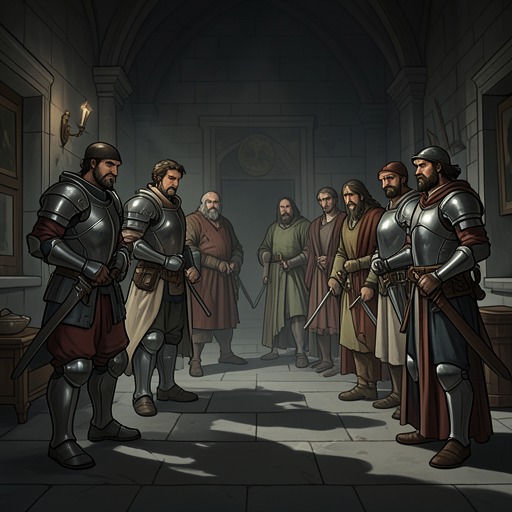
At Arthur’s court, Pellinore is treated as an experienced and trusted counsellor. After eight of the Round Table’s knights have been lost, Arthur asks him how replacements should be chosen. Pellinore recommends balancing the company with four older and four younger knights, and names leading candidates from both groups. The proposal presents him as a practical adviser concerned with the strength and continuity of the fellowship, not only as a fighter seeking individual renown.
His own place in that fellowship is marked publicly. When Pellinore comes to court with Tor, whom he identifies as his son, Arthur welcomes him. At the feast Tor is knighted first, and Merlin then takes Pellinore by the hand and designates a place for him near the Siege Perilous among the seats of highest honour. The gesture makes Pellinore’s standing at court visible: he is counted worthy of distinction, even though the Siege Perilous itself is reserved for a uniquely qualified knight and is not Pellinore’s seat.
Family and Recognition
Pellinore’s family history emerges through revelation rather than open inheritance. Tor has been raised by Aries the cowherd, but Merlin exposes that Aries is not his father and identifies Pellinore as the boy’s true parent. Tor’s mother explains that, when she was a maid going to milk the kine, a knight met her and later Tor was born; the knight had also taken her greyhound. The revelation gives Tor royal blood and clarifies why he is unlike the man who raised him.
Pellinore accepts Tor as his son and brings him to Arthur’s court, reporting that he had made him a knight at the cowherd’s request. Arthur’s decision to knight Tor first at the feast places the newly acknowledged son conspicuously within the court’s order. Pellinore’s family line later includes several other sons: Tor, Aglovale, Lamorak, Dornar, and Percivale. That lineage matters in the continuing conflicts among the knights, because Pellinore’s death becomes a source of grievance inherited by his sons.
Pellinore’s relationship to Arthur’s family is also shaped by the concealed kinship around Arthur’s birth. Lot’s wife, accompanied by her sons, comes to Arthur’s court as a messenger but has been sent to spy on it. Arthur is attracted to her, and Mordred is born; Arthur does not know at the time that the woman is his maternal sister, Igraine’s daughter. This episode places Pellinore’s later political world within a court where hidden blood ties and uncertain loyalties complicate public allegiance.
Regret and the Cost of the Quest
Pellinore’s devotion to pursuit has a personal cost. In one adventure he follows a lady and a knight, but his attention remains fixed on the quest rather than on stopping the events that lead to her death. At Camelot, he is sworn on the Four Evangelists to tell the truth of his quest. Queen Guenever reproaches him for failing to save the lady. Pellinore answers that he was so absorbed in the pursuit that he would not stay, and says that he regrets it and will regret it for the rest of his days.
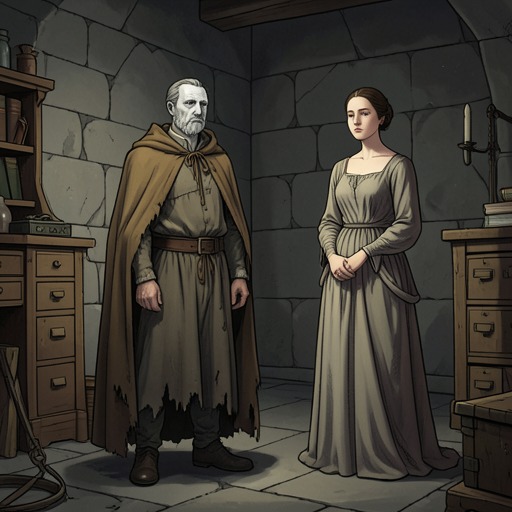
Merlin reveals the fact that transforms this failure into a family tragedy: the dead lady was Pellinore’s own daughter, and the slain knight was her beloved. The disclosure joins the quest’s outward adventure to the damage it has done within Pellinore’s own family. His prowess and persistence cannot undo the choice he made; instead, the tale records his regret as a continuing consequence of having put the chase first.
The episode also sits beside the court’s formal statement of knightly conduct. After the intertwined quests of the white hart, the brachet, and the lady, Arthur establishes rules against outrage, murder, and treason, and commands the knights to show mercy and aid women in need. Pellinore’s failure thus becomes more than private sorrow: it contrasts with the standards the king articulates for the fellowship.
King Lot, Revenge, and Death
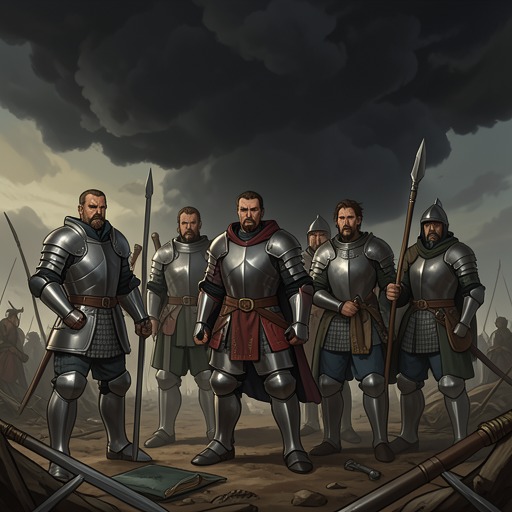
Pellinore’s martial career turns into a dynastic conflict when he fights on Arthur’s side against the Orkney host. In the battle he aims a powerful blow at King Lot but misses, striking the horse’s neck and bringing Lot down with it. Pellinore then strikes Lot through helmet and head. Lot’s death causes the Orkney forces to flee, and many are killed in the fighting. Pellinore is held responsible for Lot’s death, a blame that outlasts the battlefield encounter.
Gawaine later avenges his father. Ten years after being made a knight, he kills Pellinore with his own hands. The later family reckoning makes clear that the death has not been forgotten: Lamorak identifies himself as Pellinore’s son, and Gawaine and his brothers recognize that Lamorak will not love them because they killed his father. They also connect their hostility toward Lamorak with the shame he brought upon their mother, Queen Morgause. Pellinore’s death therefore continues to shape relations between the next generation, where remembered injury becomes a motive for further conflict.
The grief is voiced again by Pellinore’s widow, who recalls that he left her four sons and laments both his death and Lamorak’s. She accuses Gawaine and Gaheris of having slain Pellinore treacherously rather than manfully. A later judgment on the family’s losses likewise describes Pellinore as shamefully slain by Gawaine and his brother. The differing accounts register the bitterness and partisan memory surrounding the killing, while agreeing that Pellinore’s death has become a defining grievance for his household.
Narrative Role
Pellinore’s episodes connect quest-romance, courtly service, and feud. The Questing Beast gives him a distinctive recurring identity, but his story does not resolve in the achievement of that pursuit. Instead, the narrative measures his character through decisions made along the way: he risks himself in combat, advises Arthur on rebuilding the Round Table, recognizes Tor as his son, and admits lifelong regret for failing his daughter.
His fate also demonstrates how a knight’s actions travel beyond his own lifetime. The killing of Lot settles a battle in Arthur’s favour, yet it creates a debt of vengeance that Gawaine later exacts. Pellinore’s sons inherit the consequences, and their hostility toward the Orkney brothers carries the old death into the next generation. His arc is thus marked by a contrast between honour bestowed in Arthur’s court and violence that no courtly honour can contain once family loss becomes a claim for revenge.